The case, explained
Inheritance division and building violations: the Supreme Court ruling
7 min read · Updated November 2026 · Editorial oversight: Avv. Federico Papa
The Italian Supreme Court, in a recent order, clarified a crucial point regarding successions: the presence of building violations does not prevent the dissolution of an inheritance communion. The Court confirmed that the penalty of nullity under the Consolidated Building Act for transferring irregular properties does not apply to divisions originating from a succession mortis causa, settling a long-standing debate. The dispute arose among co-heirs and progressed through multiple levels of litigation. At the center of the case was a real estate complex containing structures erected without building permits, which one heir sought to use to block the judicial division. Through our twin case, we explore how the distinction between ordinary and inheritance communion affects family property and the practical risks for an heir receiving an irregular asset.

In brief
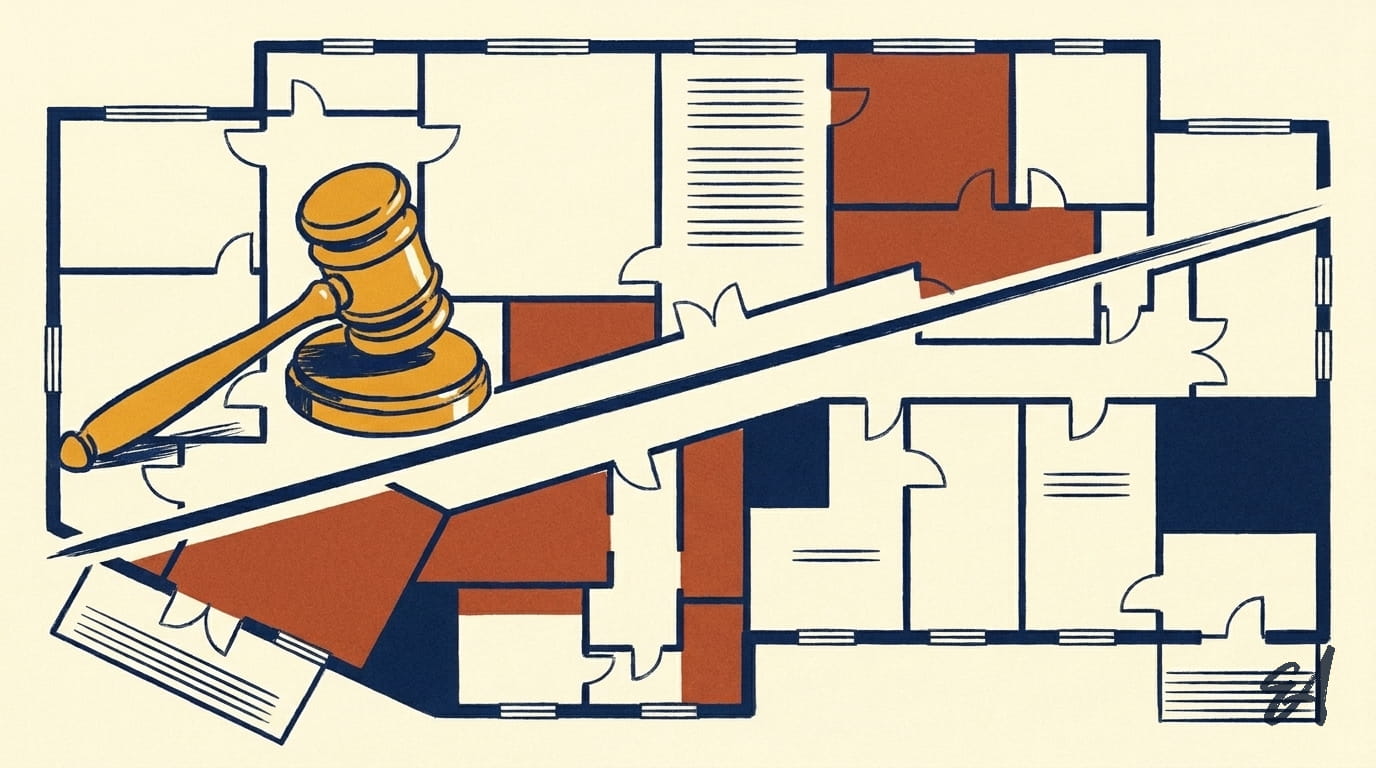
A recent Supreme Court order establishes that inheritance division is not an inter vivos act for urban planning purposes. Consequently, the absence of building permits does not invalidate either the dissolution of the communion or the judicial division. This ruling consolidates the principle established by the Plenary Session (Sezioni Unite), clearly distinguishing succession from ordinary communion, in which building irregularities bar any transfer under penalty of nullity, thereby safeguarding the generational transfer of assets.
Factual background
The case reached the Supreme Court following an appeal against a Court of Appeal judgment that had affirmed the dissolution of an inheritance communion. The appellant, a co-heir unsuccessful in the lower courts, challenged the decision on the grounds that the division of a real estate complex affected by building violations was null and void. The defense argued that the division should be treated as an inter vivos transaction, requiring, under penalty of nullity, reference to the relevant building permit or amnesty application. Both the court of first instance and the appellate court had ruled the division admissible despite the urban planning irregularities. The central question before the Supreme Court was whether an inheritance division is exempt from the strict statutory prohibitions governing the transfer of unauthorized structures, thereby allowing the allocation of shares among co-heirs despite uncorrected building discrepancies.
Relevant legal framework
The statutory framework centers on Art. 46 of D.P.R. no. 380/2001 (Consolidated Building Act), which imposes statutory nullity on inter vivos acts aimed at transferring or dissolving joint ownership of real property rights involving buildings constructed without required permits. This provision functions as a deterrent against unauthorized construction by preventing irregular assets from circulating in legal transactions. Similarly, Art. 40 of Law no. 47/1985 sets out equivalent restrictions for older structures, requiring explicit reference to the building license or permit. Conversely, Art. 713 of the Italian Civil Code grants each co-heir the absolute right to demand the dissolution of the communion, while Art. 757 of the Civil Code establishes the retroactive effect of division. Under this provision, each heir is deemed the sole and immediate owner of the assets allocated to them as of the date of the opening of the succession. This mechanism ensures continuous legal ownership between the deceased and the heirs, characterizing the division as an act intrinsically linked to the succession rather than a voluntary transaction between private parties.
Case law orientation
The Supreme Court's ruling follows the principle established by the Plenary Session (Sezioni Unite), which clarified that inheritance division does not fall within the category of inter vivos acts subject to urban planning nullity. Case law establishes that inheritance division is a mortis causa transaction or, at least, an operation completing the succession process. Since statutory law explicitly excludes successions from the scope of Art. 46 of the Consolidated Building Act, the transaction dissolving the communion among heirs is likewise exempt from nullity. The Court emphasized the distinction between ordinary communion, which originates from contract and is subject to nullity when violations exist, and inheritance communion. In the latter, the co-heir's right to dissolve the communion prevails over civil sanctions aimed at suppressing illegal construction. The governing principle is that building compliance is not a procedural condition precedent for judicial division, preventing co-heirs from remaining trapped in an involuntary communion due to irregularities attributable to the deceased.
- Try edit.legal AI
Analysis drafted and verified with edit.legal
To verify the provisions cited in this article, we used edit.legal. Test our legal AI on official sources and apply it to your own matters.
Key takeaways for legal practitioners
- When advising on the dissolution of joint ownership, practitioners must immediately determine whether the co-ownership arises from succession or an inter vivos contract, given the opposing consequences regarding validity when building violations exist.
- Clients must be informed that securing a judicial division of an irregular property does not render it marketable: while the allocation title is valid, alienation remains barred until an administrative amnesty is secured.
- Counsel must carefully frame instructions for Court-Appointed Experts (CTU) to ensure asset valuations factor in estimated regularization costs or the diminished market value resulting from non-compliance.
- Where substantial cash equalizations are agreed between co-heirs, practitioners should carefully assess whether the division retains its character as a transaction tied to succession or risks reclassification as a partially conveyancing transaction for value.
References: Art. 46 D.P.R. 380/2001Art. 40 Legge 47/1985Art. 713 Codice CivileArt. 757 Codice Civile
Related cases

Frequently asked questions
Can I sell my share of an inherited illegal property to third parties?
No, the sale of a share to a third party constitutes an inter vivos transaction subject to statutory nullity under Art. 46 of D.P.R. 380/2001, unlike a division among co-heirs.
What happens if the judge assigns an illegal lot that cannot be legalized?
The allocation remains valid, but the recipient heir acquires property exposed to a demolition order or incapable of legal transfer, resulting in a severe reduction in commercial value.
Does urban planning nullity apply if the heirs decide to divide assets before a notary?
No, case law extends the exemption from urban planning nullity to both judicial and contractual divisions, provided the transaction dissolves an inheritance communion.
Verified legal research and drafting with edit.legal
Legal research and drafting with citations checked against official databases. edit.legal is free to try, no credit card.
Try edit.legal for free